
Demystifying AI in Safety: Understanding Its Role and Potential in Workplace Protection
AI-Enhanced Safety Engagement Series – Part 2 of 7
In Part 1 of this series, we introduced the “between events” gap: those everyday moments between audits, inspections, and scheduled training where actual work unfolds and real risks emerge. Safety programs tend to perform well during formal events, yet injuries rarely occur during those times. They emerge when work speeds up, focus wanes, or when a minor shortcut seems harmless.
If you haven’t yet read Part 1, we recommend starting there to establish the groundwork for the series that follows:
Part 2 focuses on clarity.
AI is now central to nearly every safety technology discussion. Yet much of the discourse is either excessively technical or wildly exaggerated. For safety leaders, this creates genuine challenges. When AI is misunderstood, it either becomes overly trusted or entirely dismissed. Neither outcome aids in preventing injuries.
Let’s take a moment to demystify AI in safety in straightforward language.
AI in safety often appears as a buzzword tangled in technical jargon and unfulfilled promises. You may wonder what it truly accomplishes—and what it doesn't do—for workplace safety. This post cuts through the noise, explaining AI safety management in clear terms, so you can understand how it helps identify risks early and supports your decisions without replacing the critical human judgment. For further reading, check out this resource on AI's role in improving workplace safety.

Why clarity matters more in safety than in almost any other function
Safety is not a place where vague claims belong. When teams misunderstand AI, they either over-trust it or reject it completely. Over-trust leads to disappointment and complacency. Rejection leads to missed opportunities to improve visibility and consistency.
The most credible AI guidance in business is consistent on one point: value comes when organizations apply AI to specific problems, put governance in place, and redesign workflows so humans and technology work together. McKinsey’s research on AI adoption repeatedly shows many organizations are using AI, but scaling value requires operational changes and controls, not hype.
That is exactly how safety leaders should approach AI: narrow use cases, clear guardrails, and practical workflow support.
First, separate three concepts that get mixed up constantly: AI vs automation vs analytics
Most “AI in safety” confusion comes from people using one term to describe three different things. These are not the same, and the differences matter.
Automation executes tasks. It is the engine that sends reminders, routes forms, assigns training, and tracks completion. It saves time, but it does not interpret meaning.
Supportive examples:
Assigning a toolbox talk to a crew every Monday
Sending a follow-up reminder to anyone who has not completed it
Routing a digital sign-off to a supervisor
Analytics reports what happened. It summarizes history and shows trends you can observe after the fact. It is useful, but often delayed by reporting cycles.
Supportive examples:
Monthly completion rates by location
Incident counts by type
Corrective action closure rate over the last quarter
AI helps spot patterns and prioritize action. It can scan messy inputs and surface signals earlier than a human team can realistically review across shifts, sites, and time. It does not replace leadership. It improves visibility and decision support.
AI's Role in Supporting Safety
AI enhances safety by identifying risks and supporting decision-making. It processes data swiftly, detecting patterns that might be missed by the human eye. This proactive approach helps prevent incidents before they happen.
Consider a scenario where AI identifies a recurring safety issue. By alerting safety leaders to this pattern, AI enables targeted interventions. This results in a safer workplace without replacing human oversight.
Differentiating AI, Automation, and Analytics
AI, automation, and analytics are often confused. However, each plays a unique role in safety management.
Understanding Key Differences
AI analyzes data to uncover patterns and insights. Automation manages routine tasks like sending reminders. Analytics reports on past performance. Understanding these differences aids in effectively applying each.
For example, automation can streamline safety checks, while analytics offers insights into historical data. AI, however, excels at predicting potential risks based on current data.
How Each Supports Safety
Each tool serves a specific purpose. Automation reduces manual efforts, analytics offers a retrospective view, and AI anticipates risks. Together, they form a robust safety support system.
For instance: automation sends regular safety reminders, analytics tracks past incident trends, and AI predicts future risks. This combination ensures a comprehensive safety strategy.

Common Misunderstandings
A common misconception is expecting AI to manage all aspects of safety. Remember, AI is a tool for insights, not a replacement for human judgment. It excels in data-centric tasks, but human oversight remains essential.
AI's Practical Applications in Safety
AI's benefits in safety are significant. Here, we explore how it aids pattern recognition, trend detection, and decision support.
Enhancing Pattern Recognition
AI's strength lies in identifying patterns across data. It swiftly processes vast amounts of information, revealing hidden trends that might indicate potential hazards.
For instance, if AI detects a pattern of near-misses in a specific area, it alerts leaders. This enables timely interventions, reducing the risk of accidents.

Trend Detection in Safety Programs
AI excels at spotting trends over time. It can identify gradual changes in safety engagement, signaling when attention is needed to prevent incidents.
For example, a decline in safety training participation might signal a growing risk. AI highlights this trend, allowing for corrective measures before issues arise.
Decision Support for Leaders
AI supports leaders by prioritizing risks. It provides actionable insights, helping to focus resources where they are most needed. This ensures safety efforts are both effective and efficient.
Imagine AI identifying which safety training modules are less effective. Leaders can then adjust the content, ensuring that safety education remains relevant and impactful.
Limitations of AI in Safety
AI has its limitations. Understanding these limitations ensures it is used effectively within safety programs.
AI is Not a Replacement
If you only remember one part of this article, make it this section.
AI is not a replacement for safety professionals. OSHA’s Recommended Practices for Safety and Health Programs are built around management leadership and worker participation, hazard identification, prevention and control, education and training, and ongoing evaluation. Those are human responsibilities supported by systems, not delegated to them.
AI is not a magic prediction engine. It can surface risk signals, but it cannot guarantee outcomes. Risk is shaped by real-world behavior, changing conditions, and leadership response. AI can help you see issues sooner, but you still have to act.
AI should never be a black box that “runs safety.” In safety, explainability matters. Auditability matters. Defensibility matters. If a system cannot clearly show what it is doing and why, adoption will suffer and the program will lose trust.
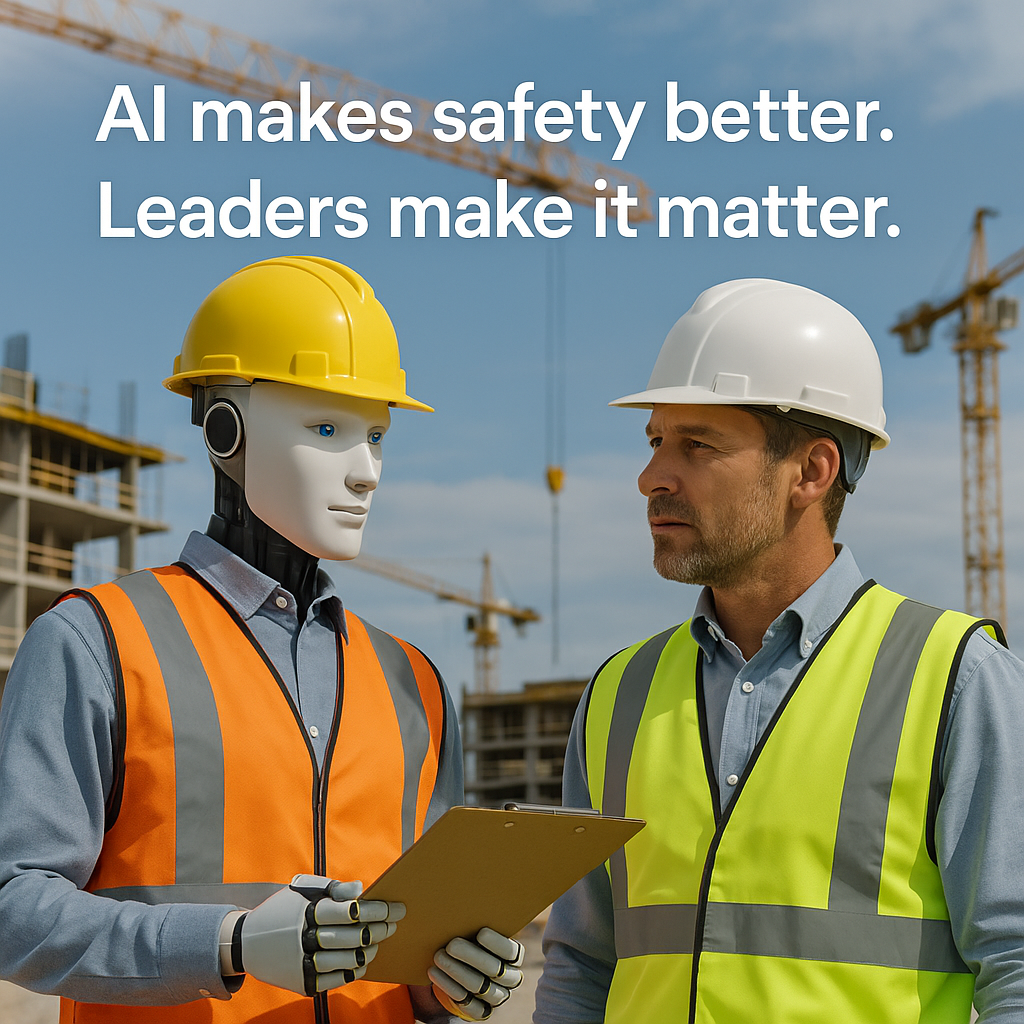
AI's Predictive Limitations
AI predicts based on data, but it cannot foresee every outcome. It signals potential risks but cannot guarantee incident prevention.
Consider AI detecting an increase in slip incidents. While it indicates a trend, human analysis is needed to understand the context and implement solutions.
Importance of Transparency
Transparency in AI is vital. Safety leaders must understand AI's insights and limitations to maintain trust and effectiveness in safety programs.
When AI provides risk assessments, leaders should ensure these insights are clear and actionable. This transparency builds confidence and encourages adoption.
Connecting AI to Safety Engagement
This is where Part 2 reconnects directly to Part 1. AI does not close the between-events gap by itself. What it does is help leaders see where that gap is widening.
When engagement drops, comprehension weakens, or follow-through lags, those are early signals that risk is rising. OSHA defines leading indicators as proactive measures that can shed light on the effectiveness of safety and health activities and reveal potential problems in a safety program.
That framing matters because it puts AI in the right place. AI helps surface leading signals earlier. Leaders use those signals to intervene earlier. That is prevention.
Addressing the Between-Events Gap
AI helps fill the safety gap between scheduled activities. Maintaining engagement, it ensures safety awareness remains consistent over time.
For example, AI can send daily safety tips to workers, keeping safety top-of-mind even between formal training sessions.
Real-World Application Examples
Here is a simple scenario that shows the difference between “AI hype” and practical support.
A worker reports a near miss, but the report is vague. It says: “Almost got hit by material.” That happens all the time. The intent is good, but the details are not actionable. Without details, the investigation becomes guesswork. Guesswork leads to weak corrective actions. Weak corrective actions lead to repeated exposure.
AI adds value when it quietly improves the input. It can prompt for missing context in a way that does not feel like paperwork. It can ask short, practical questions such as: What material was involved? Where did it happen? What task was being performed? Was the equipment in motion? Was there a spotter? Those prompts improve the narrative at the source.
The outcome is not “AI solved safety.” The outcome is more practical: the safety team gets a usable report, a supervisor can respond faster, and corrective action selection improves because the problem is described clearly.
That is the kind of AI safety leaders should want. Less friction, better clarity, faster action.modONE's Practical Approach
modONE leverages AI to enhance safety without overstating its capabilities. It focuses on engagement and consistency, ensuring that AI supports rather than replaces human oversight.
By using familiar communication channels, modONE makes safety engagement seamless. AI-driven insights help prioritize safety efforts, ensuring they are both effective and efficient.
For more on modONE's approach, visit their blog.
By clarifying AI's role and limitations, we can use it to improve safety programs effectively. AI is a tool for insights and support, not a replacement for human judgment. As we continue this series, we will explore AI's role in leading indicators and proactive safety management.

About the Author
John Turner is the Chief Commercial Officer at modONE, where he focuses on helping organizations improve safety outcomes through consistent, frontline engagement and measurable leading indicators. He works closely with safety leaders, brokers, and risk professionals across construction, manufacturing, logistics, and other high-risk industries to modernize safety programs without adding administrative burden.
John’s work centers on practical safety execution, bridging the gap between compliance requirements and real-world behavior on jobsites and shop floors. He is particularly focused on how engagement, simplicity, and responsible use of technology can reduce incidents, improve culture, and support defensible safety programs.
You can explore more of John’s writing on safety engagement, leading indicators, and risk reduction on the modONE blog